
Royal at Riverside
- abamerica1776
- Dec 15, 2021
- 12 min read
The annals of presidential gravesite architecture are filled with wonderful stories and accounts of how our large presidential memorials came to be. Beginning with George Washington and ending most recently with John Kennedy, large gravesites are common among our Chief Executives. The symbolism or lack of depending on the gravesite, the materials of granite and/or marble used in their construction, embellishment through bronze castings, and fine detail work to simple aesthetics of these memorials are what make this topic worthy of study, discussion, and, best of all, personal visits. Of these large memorials, three of them feature a stately dome, an easily identified element that sets them apart from the rest. And of these three, two of them are based on, or perhaps better stated, inspired by European memorials. And of these two, it is the memorial of President Ulysses S. Grant that takes a great deal of inspiration from the mausoleum of a brilliant military tactician who led French armies to victory in the late 18th and early 19th century before meeting his end at the hands of British and Prussian forces at the Battle of Waterloo in 1814.
If you haven’t guessed who this man or you’ve been living under a rock for most of your life, his name is Napoleon Bonaparte. Following his failure at Waterloo, Napoleon was exiled to St. Helena (transported by the British aboard the HMS Northumberland) where he lived out the remainder of his life, dying on May 5, 1821. In his Will, Napoleon made it clear it was his wish to be returned to France and buried in Paris, writing “it is my wish that my ashes may repose on the banks of the Seine, in the midst of the French people, whom I loved so well.” Despite that wish, after his death, Napoleon was buried on St. Helena, where he remained for nearly 20 years. It was this time King Louis Phillipe and his diplomat, Adolphe Thiers, requested permission from the British to have Napoleon’s remains disinterred and taken home to his beloved France. Permission was granted, his remains were disinterred, his coffin was checked to verify his remains (they were indeed his), and his coffin was loaded on a ship and set sail for France. On December 15, 1840, in the capital of Paris, the penultimate funeral was given for the former emperor. His remains were escorted to from the Arc de Triomphe along the Champs Elysées and the Place de la Concorde to the Esplanade des Invalides and interred in a sarcophagus inside the Royal Chapel, where they remained until 1861, at which time they were removed, yet again, and placed inside a grand sarcophagus with a recessed crypt under the mighty dome of the Royal Chapel.
Les Invalides has a grand sound to it, a bit of panache, its French intonations rolling off the tongue. But wipe away the veneer and when translated to English, it simply means The Invalids. (also goes by the title of Hotel National des Invalides-House of the Disabled). In its heyday, Les Invalides was a former military hospital complex with myriad rooms, anchored on the ends by a massive, enclosed courtyard (1 of 15 in total) and a massive Royal Chapel. In its current form, Les Invalides houses several military museums (well worth the price of admission) chronicling the military history of France. And Royal Chapel, in addition to housing Napoleon’s sarcophagus, it also houses the sarcophagi of famous French military leaders as well as two of Napoleon’s brothers.
The construction of Les Invalides was ordered by the Sun King himself, Louis the XIV in 1670 and was overseen by architect Libéral Braunt. Six years later, and in need of a place of worship for soldiers and the king, construction began, this time overseen by architect Jules Hardouin-Mansart on the St. Louis Cathedral, comprised of the Veteran’s Chapel and the Royal Chapel. Of significance to our interest is the Royal Chapel. It is a towering French Baroque edifice that rises to 351 feet over the Parisian landscape (the tallest dome in Paris). As the name implies, the Royal Chapel was to be used by King Louis XIV, but in reality, he rarely “graced” the chapel with his presence. As for the main occupants of Les Invalides, the soldiers worshipped inside the Veteran’s Chapel. And, although both king and solider could worship at the same time, due to the etiquette of the time, king and soldier had separate entrances.
In 1800, on order of Napoleon, the remains of Henri de La Tour d'Auvergne, Viscount of Turenne, or known by his simpler name, Turenne, and his sarcophagus were placed inside the Royal Chapel, setting the stage for its transformation into a mausoleum for France’s great military leaders. After Napoleon’s internment in the Royal Chapel, excavations began under the rotunda to provide a royal, beyond luxurious site of rest for the former emperor. Why excavations? Well, architect Louis Visconti’s design called for a sunken crypt and stairway. It was a massive job made more difficult by his grand vision. Although he didn’t live to see its completion, come Tuesday, April 2, 1861, the Royal Chapel was ready to receive its main occupant and so it did in the style and grand fashion befitting a former French emperor. And the earlier mention of king and soldier worshipping at the same time in their respective chapels made possible through the use of separate entrances was made permanent when Napoleon’s mausoleum was constructed inside the Royal Chapel by way of a wall erected between the Veteran’s and Royal chapels in order to create an exclusive pantheon of France’s great military leaders.
Inside the cavernous interior of the Royal Chapel, under the soaring rotunda, is a wide oculus that gives a bird’s eye view of the sunken crypt and Napoleon’s massive sarcophagus. Resting atop supports, his sarcophagus stands 16.4 feet high, stretches to just over 13 feet, and is 6.5 feet wide. Branching out from this main room are four small reliquary rooms anchoring each corner of the Royal Chapel, each with their own sarcophagus. Located between the two small rear rooms is a stairway that leads down to a hallway that takes visitors to a circular walkway (lined with 10 bas reliefs depicting Napoleon’s accomplishments as emperor of France) around Napoleon’s sarcophagus (his body secured by five coffins, each one made of either exotic wood or metal and larger than the previous), surrounded by 12 white marble Victory statues. Simple and ordinary this layout around the sarcophagus is, and that of the Royal Chapel as well, the page length necessary to describe the myriad symbols and details around Napoleon’s sarcophagus would be better served by a multi-page presentation.
Found throughout the chapel interior are faux Corinthian columns; bas relief panels of biblical figures interposed with articles of antiquity; intricate, detailed ceiling paintings filled with cherubic angels, religious figures, men of stature giving up the ghost as their friends and counterparts look on; transitions from the corporeal to the angelic; and four massive arches that anchor this display of the might and power of the monarchy. This brief description in no way is meant to adequately describe the grandeur of the Royal Chapel. But suffice it to say it is a monument to wealth and luxury with an obvious desire to eternalize Napoleon as the closest approximation to a god on earth among men relying heavily on the divine.
Although I’d like to spend more time discussing the Royal Chapel, we must move on to more important matters and learn or at least attempt to get an understanding of how the Royal Chapel inspired much of President Grant’s memorial in New York City. Fast forward to McGregor Cottage, July 23, 1885, Wilton, NY, where former President Ulysses S. Grant passed away from throat cancer. Almost immediately, questions arose over where he was to be interred. There were three options: St. Louis, Missouri (spent time there before the Civil War); Galena, Illinois (where he received his first general’s commission); or New York City (where he spent his later years). Of these three, New York City was chosen, which brought with it its own question of where he would be interred in New York City. Mayor William Grace sent a telegram to McGregor Cottage offering Grant’s family an interment site in one of the City’s parks. The Grant’s requested that for them to accept the offer permission would have to be granted allowing Julia Grant to be interred next to her husband. Permission was granted and with it work began on choosing a city park location. Mayor Grace offered Riverside Park, a location north of the city and situated along the high banks of the Hudson River. But it was deemed too far from city center and difficult to reach. Mayor Grace was of the mind that this location, with pristine views and no visible obstructions, would be an ideal spot for a grand memorial welcoming visitors to the city sailing down the Hudson River rivaling those of Europe situated on its grand rivers. (Word of Riverside Park made its way to the New York City press and the New York Times and New York Tribune offered their own thoughts on where to inter the former president, both newspapers advocating for Central Park.) Although Riverside Park was a great location, three other sites were considered: Central Park Mall, Great Hill (also known as Watch Hill) near 105th Street, and Union Square Plaza at the 59th Street entrance. Central Park Mall was initially chosen, its wooded and forested appearance being deemed a suitable site for Grant’s Memorial, but it was soon dropped when planners thought the memorial would be lost against the natural scenery. Great Hill, much like the Central Park location, was a beautifully wooded and natural area but it was nixed after it was learned the memorial would be near a future cancer ward and the powers-at-be thought it would be in bad taste to have cancer patients looking at a memorial of a well-known American figure who died from cancer. Turning to the 59thStreet location, it, too, was soon dropped due to the overwhelming amount of pedestrian traffic and overall congestion. With these three sites no longer viable, attention turned back to Riverside Park. Mayor Grace, joined by Frederick Grant, toured the site. Frederick found it just as Grace had promoted it-free of obstructions and naturally beautiful. It took little convincing on Grace’s part. Frederick approved and the site was selected. In the meantime, after a massive funeral in New York City, Grant was interred in a hastily built temporary vault on the future site of the memorial, remaining safely guarded for 12 years.
Two days after Grant’s death, the Grant Memorial Association (GMA) was formed with the express purpose of overseeing the design and construction of a permanent memorial for Grant. In 1887, when the GMA circulated its first design competition, there were 18 rules for submissions. Some of these 18 rules brought swift complaints from the Architectural League of New York and the American Institute of Architects, among others. Among the complaints, the rules provided by the GMA were counter-productive in securing the best talent and subsequent designs; cost of the memorial or cost not to be exceeded was not provided; design judges should have been made known; design rates were too low and unused designs should be returned to the architects; the winning architect should be paid at a regular rate; non-standardized scales of measurements; and competition compensation rates should be sufficient to secure quality architects. And, though not mentioned by either professional architectural group, another of the 18 rules was for the memorial to be “heroic in character, military in form, and not suggestive of any other design, ancient or modern.” Well, being there were a lack of grand memorials for dead war heroes/presidents in the United States at the time the competition was held, architects had to look elsewhere, primarily Europe, for ideas. And naturally, many of the European memorials that were being looked at borrowed from antiquity and used a great deal of Grecian and Roman design. A rather difficult rule to adhere to, even in the present.
As a result of these misguided rules the design competition did not end well, and the GMA was unable to secure a winning design. Criticism forced the GMA to issue new rules and guidelines along with a memorial price tag of $500,000 but even with the improved rules and guidelines, securing a design would prove to be a challenge. The first design call went out on February 4, 1888 and closed on January 10, 1889. In total, sixty-five designs were submitted. Despite five designs being chosen by the GMA, it found the competition did not attract top talent and did not produce the caliber of drawings it felt merited consideration to be the final resting site of Grant. It is important to note or perhaps more interesting that of the five designs chosen by the GMA, three of them had a prominent central shaft, and the fourth one bore resemblance to the current memorial. The look and features of the fifth design are unknown. Failing to secure a design, the GMA issued another call for designs in April 1890, including a new set of guidelines. The GMA also made it known that it envisioned the mausoleum as being spacious with “such altitude and capacity as to present an attractive elevation and afford ample room within it, not only for the sepulcher of General Grant and his wife, but also for a memorial hall.” Grand vision?, check-this certainly makes the design process easier. New set of guidelines?, check. Just one more addition: there would be no mass call for designs. Instead, the GMA invited five men to submit designs. In October, the GMA selected the winning design of New York architect, John H. Duncan. Duncan explained his design as such, “the problem is to produce an edifice, which shall be unmistakably a Monumental Tomb, no matter from what point of view it may be seen.” His solution, “...there must be the expression of repose and dignity in the architecture, conforming in character with [the] Hero we intend to honor…and the treatment must be that of Unity, and not a mass composed of conglomerate parts, while I have ever kept in mind and provided for certain portions of the main structure to be built from time to time, with the amount of money in hand, and provided that such parts as they are completed shall give the appearance of a completed structure, so far as this is possible.”
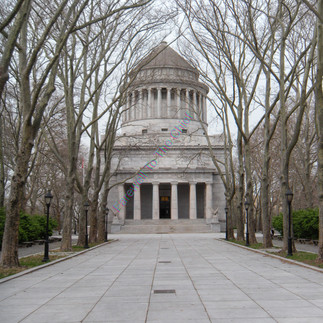
So where do the final resting sites of Napoleon Bonaparte and Ulysses Grant intersect in this realm of design memorializing eternal slumber. While the exteriors of both mausoleums are different-Duncan borrowed in large part from the square shapes and columns of the Tomb of Halicarnassus (Caria, Turkey) and the Tomb of Hadrian (Rome) and the mausoleum’s most striking exterior feature, a stepped conical dome supported by a Doric colonnade that resembles the stepped circular dome that sat atop the Tomb of Hadrian-it is the interior of the Royal Chapel, namely its layout and structural features (four bays and four roman arches, oculus, below-ground crypt, and location of sarcophagus) that are mirrored in Grant’s mausoleum. (For those of you in the know, the three panel paintings found in the lunettes above the bays depicting General Grant from the Civil War were added in the 1960s. It would be a hard sale to argue their inclusion was to mimic the use of paintings found in the Royal Chapel as those paintings are richly symbolic and metaphysical contrasted against the historical paintings of General Grant at Appomattox Courthouse, Vicksburg, and Chattanooga.) So, the simple question is: why did Duncan borrow so heavily from the Royal Chapel for his interior layout? That is the million-dollar question. I’ve no access to Duncan’s drafting board internal-monologue deliberations but one salient piece of in
formation that may help to explain is the GMA’s initial design competition requirement that the mausoleum appear “heroic in character, military in form...” In Duncan’s letter to the GMA explaining his design, he mention’s Napoleon’s mausoleum one time on page three of his eight-page letter, writing “While my arrangement of plan recalls the tomb of Namolean [sic] in the Hotel des Luvalides, so far as the depressed crypt is concerned I cannot see how that can be avoided (it certainly cannot be improved upon) [sic] I have placed my crypt in an apse and furnished a large space around the Sarcophagus, so as to leave the entire portion of the Memorial Hall clear for any Patriotic or Civic Gathering…”. This is the extent of Les Invalides’ mention in Duncan’s explanation for Grant’s mausoleum. Duncan’s plan proposed a sunken crypt and sarcophagus, as is found in the Royal Chapel, but located in an apse along the north wall, leaving the memorial hall open and unobstructed. As the project moved forward, deliberations between the GMA and Duncan resulted in the apse being removed and the crypt and sarcophagi being placed in the middle of the memorial hall, reflecting more closely the layout of the Royal Chapel. So, we are left with two primary features borrowed from the Royal Chapel: the floor plan and the sunken crypt. The remainder of the artistic and architectural elements found in the Royal Chapel, such as the bas reliefs depicting Napoleon’s accomplishments and life that line the wall around his crypt, were not included in Duncan’s final design, which, for you intrepid explorers who have visited Grant’s mausoleum, may recall how sparsely embellished it is despite it being North America’s largest mausoleum.
Initially, when I set out to write this post, I was hopeful I’d find a treasure trove of letters, drawings, and the like that would help explain why Duncan borrowed as much as he did from the Royal Chapel. But I came up with little to explain his thinking other than a fairly reasonable guess that he looked at the Royal Chapel’s interior as a fitting heroic style to mirror for its main and mighty military occupant. Whatever reasons Duncan had for using the Royal Chapel we’ll never know. But what I do know is he left us, and President Grant, with a fitting mausoleum for one of America’s greatest military figures. It has no equal. And I hope it continues to stand for decades to come as one of our greatest memorials.







This was the winning design submitted by John Duncan. Absent in the present are the numerous statues and the iron gates seen behind the columns.


Comments