
Martha Washington
- abamerica1776
- Jan 19, 2023
- 4 min read
Updated: May 22, 2023
First Death of the First Lady
Historical records are lacking on the events surrounding Marth’s death on Saturday, May 22, 1802. Unlike the first-hand account provided by Tobias Lear of George’s death, there is no first-hand account of her passing. For those relatives who were at Martha’s bedside, their first-hand accounts were either kept private or, if written down in a diary or letter, they’ve been well hidden, or lost to history. Newspaper and book search results are no better. Fortunately, there is some information, as little as it is, that provides some details and allows us to create a mental picture of her death.[1]
In the era of Washington, and him being the owner of the estate, it was custom to close the bedroom until the next Washington male heir took over the estate; this came about in 1802 after Martha’s death when Bushrod Washington took over ownership. This custom of closing the bedroom aided Martha greatly because she wanted to reduce the daily vivid reminders of her husband; she also closed off his office. For the remaining two and half years of her life, Martha moved to a third-floor bedroom with a single window, which it is claimed she used to look upon the old brick vault.[2]
By spring 1802, Martha’s health began a rapid decline, and it was noticeable among visitors to Mt. Vernon. On or around Wednesday, May 5, 1802, Martha’s had an “attack of bilious fever.” Bilious fever, a term popular in Martha’s era, was a bit of a catch-all for several symptoms, an obvious one being fever, along with headache, abdominal pain, and, in some cases, constipation. Interestingly, malaria and typhoid were designated as bilious fever, which is not to say she had either, but she certainly could have suffered from either one, which would make sense in her case due to the rapid onset on her malady. At any rate, throughout the fourteen days of illness, she suffered from a fever, diarrhea, nausea, vomiting, and general discomfort. Given the time period of her death, time of year, location near the Potomac River, along with the reported complications, an educated guess would be typhoid fever. Her personal doctor was summoned and, although he could do little, he offered whatever aide he could to alleviate her condition.
Martha, ever prescient, prepared for her death without fear and accepted her fate. She requested and received the last rites. And, as one of her final acts, she sent for a white dress. Late in the evening of May 22, Martha, resting comfortably in her third-floor bedroom, spoke to her family gathered around her bed about “their respective duties through life…the happy influences of religion upon the affairs of the world…and of the hopes they held out of a blessed immortality.” She passed away at age 70, just a couple weeks shy of her 71stbirthday.
Three days after her death, Martha, dressed in the white dress she sent for before her death, was given a memorial service. Her leaden coffin, secured inside an outer coffin, was consigned to the old brick vault, and placed atop trestles next to her husband’s coffin box.
That Martha was married to George, the tale of her gravesite is the tale of her husband’s gravesite. For all the numerous attempts to move George’s remains to Washington, D.C., or to Richmond, Martha was part of the conversation. The story on this part of her final chapter, again linked to her husband, had one caveat: had a removal been successful, she was to be included and placed at her husband’s side, and at her husband’s side is where she remains. Over the last 220 years, Martha and George have stayed together, side by side, beginning in the dark, dank confines of the Old Brick Vault to the interior of the new brick vault. And since 1838, husband and wife have rested in the open vestibule inside beautiful marble sarcophagi, the gift of marble and stone cutter John Struthers, chiseled in Philadelphia by John Hill under the direction of Struthers. Unlike the heraldic shield relief on the lid of George’s sarcophagus, Martha’s lid is adorned with a simple inscription,
“Martha, Consort of Washington.”
Struthers reason/s for designing a plain sarcophagus for Martha is unknown but a purely speculative guess would be George, having been the country’s first President, was given a design befitting his former title and role.
Commentary On Her Death
The Daily Advertiser, New York, NY: “At Mount Vernon, on the 22nd instant, Mrs. Martha Washington, widow of the late illustrious General George Washington, to those amiable and Christian virtues, which adorn the female character, she added dignity of manners, superiority of understanding, a mind intelligent and elevated-the silence of respectful grief is our best eulogy.
Bibliography
- Clark, Ellen McCallister. Martha Washington: A Brief Biography. Mt. Vernon, VA, Mt. Vernon Ladies Association, 2002.
- Federal Writers’ Project Works Progress Administration. American Guide Series. Washington, City and Capital. Government Printing Office, Washington, 1937.
-“Mrs. Martha Washington,” The Genius of Liberty (Morristown, NJ) 28, May 1802.
-“Died,” Daily Advertiser (New York, NY) 8, May 1802.

Library of Congress.
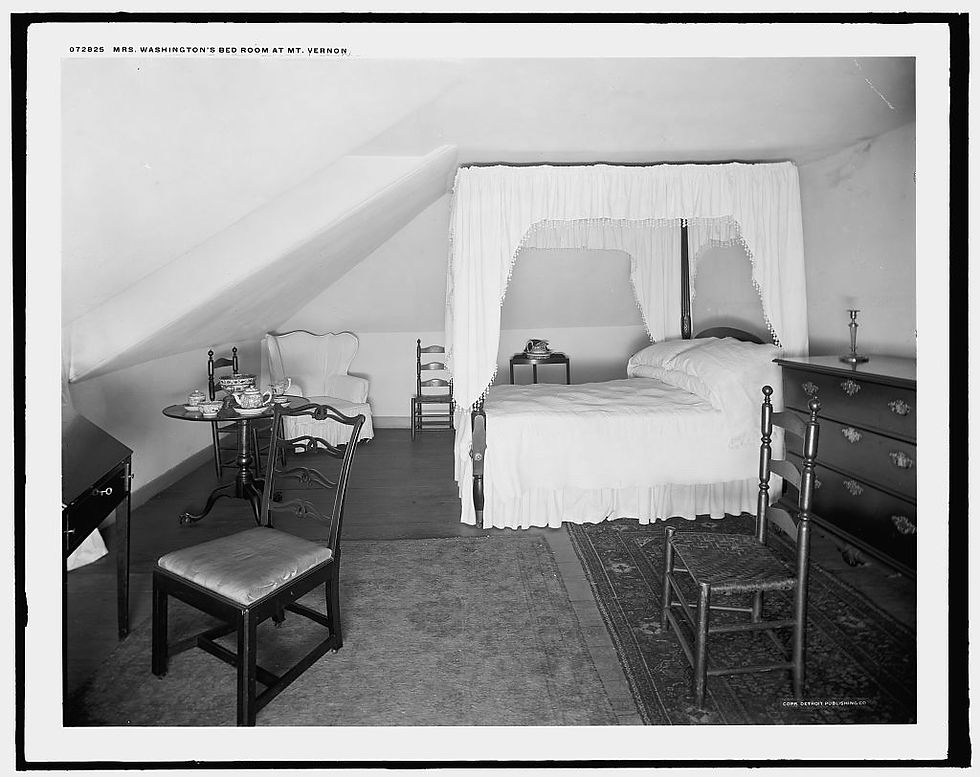
Her third floor bedroom. Library of Congress.

Her unadorned sarcophagus.


Comments