
Monroe's Iron Works
- abamerica1776
- Jun 24, 2022
- 7 min read
High atop the bluffs of Richmond, overlooking the James River, rests Hollywood Cemetery, a beautiful rural necropolis for several well-known and prominent government officials and over 18,000 Confederate soldiers. Among those officials, two served in the country’s highest office: James Monroe and John Tyler. In the case of Monroe, despite being a native-born Virginian, he was not interred in Hollywood Cemetery at the time of his death because, 1) after he died, he was interred in New York City, and 2) Hollywood Cemetery began operations in 1849. How did he come to rest in Hollywood Cemetery? And how did, what is perhaps the most elegant gravesite among the presidents, and known locally as the Bird Cage, come to stand over his grave?
Before diving into the meat of this discussion, it’s important to note that James Monroe is a not just another president in a long line of presidents. Monroe has a storied and eventful history that began during the Revolutionary War as a young enlistee in Third Virginia Infantry that saw him fight alongside George Washington at the Battle of Trenton in December 1776. Six years later, his career in public service began when he was elected to the Virginia House of Delegates and from this point it quickly accelerated, followed by him serving in the first Continental Congress under the Articles of Confederation, election to the US Senate, appointment by President Washington as minister to France, two governorships of Virginia with appointment as minister to England in between, appointment as Secretary of State and War under Madison, and finally, he was elected as our fifth president for two terms. It was a productive and relentless forty-three years of public service. At the conclusion of his presidency, he retired to his home, Oak Hill, with his wife, Elizabeth. With her death in September 1830, Monroe moved to New York City and lived out his remaining months with his daughter, Maria, and son-in-law, Samuel. He passed away July 4, 1831 and was interred in Marble Street Cemetery, where he remained for twenty-seven years.
Monroe, the third president to die on the fourth of July, and the country’s 55th anniversary celebrating its independence, was given a spectacular send-off in New York City. Aside from it being the country’s first large-scale presidential funeral, it set in motion a twenty-seven-year wait that culminated with his return to his native Virginia soil. The removal and return to Virginia began in early 1858, the 100th anniversary of Monroe’s birth, with a simple gesture by a native Virginian (name unknown) living in New York City who wanted to place a memorial at the site of Monroe’s internment, the Gouverneur vault in Marble Cemetery. He brought his request to the Common Council and at the same inquired with Virginia Governor Nicolas Wise if he had any desire to see Monroe removed to Virginia. Gov. Wise brought the matter to the state legislature and in early April, with permission obtained from Monroe’s descendants, the state gave its consent to the removal. Over the next two months, plans were made by officials in New York City and Richmond. New York officials, having to relinquish their guardianship of the fifth president’s remains, could have easily removed him from the Gouverneur vault and sent him home with little pomp to mark the occasion. But, knowing this was a major affair and that southern officials were sure to plan a major welcome for their native son, New York City officials planned an extravagant farewell that was akin to a second funeral, but more of a funeral-turned-goodbye memorial minus the burial that included a public viewing at City Hall. In Richmond, officials made plans for a welcome ceremony at the James River wharf followed by a funeral parade to Hollywood Cemetery for the internment ceremony. It was to be a grand spectacle.
On the early morning of July 2, Monroe’s coffin was removed from the Gouverneur vault. His coffin, badly decayed, was replaced, and taken to City Hall under military escort for a brief Public Viewing. Although the crowd that passed through the Governor’s room was not as large as was seen during Monroe’s first funeral twenty-seven years earlier, it was still an impressive showing, with many of the faces in the crowd having passed by Monroe’s coffin for a second time. With no time to spare to adhere to a strict schedule to ensure Monroe arrived in Virginia on July 4 for country’s 82nd anniversary, Monroe was taken to Pier 13 and loaded onto the steam ship Jamestown. Late in the afternoon, the Jamestown embarked for Norfolk, arriving right on schedule on the morning of July 4, where it turned into Chesapeake Bay and then further inland into the wide headwaters of the undulating James River, arriving on the morning of July 5 at Rockett’s Wharf in downtown Richmond.
Monroe’s remains were given a hero’s welcome on their arrival at the wharf. It was a celebratory occasion witnessed by thousands of locals excited to see such a rare spectacle, the homecoming of their native son and fifth U.S. president received by uniformed military units and the state’s highest government official, Gov. Wise. Despite the grand reception, little time was wasted marshalling the military units and government officials, in carriage and on horseback, into parade formation and placing Monroe’s coffin on a horse-drawn hearse for the procession to Hollywood Cemetery, arriving around 1:00 PM. Inside the city’s sparsely populated but premiere necropolis, a hastily built covered stage was erected near Monroe’s brick-lined gravesite; New York’s 7th regiment, which accompanied Monroe’s remains to Richmond, formed a square around the stage to prevent onlookers from using it or from hanging on it to catch a better view of the event. Monroe’s hearse stopped near the grave, carriages were exited, horses dismounted, and officials took their seats on the stage. Gov. Wise took to the lectern and gave a eulogy on Monroe’s accomplishments and his rightful place in the soil of the Old Dominion. After Wise gave his remarks, Monroe’s coffin was lowered into the ground and the burial rites were read. With the silence of the city mixed with the sounds of the James River far below the bluffs, three artillery volleys boomed.
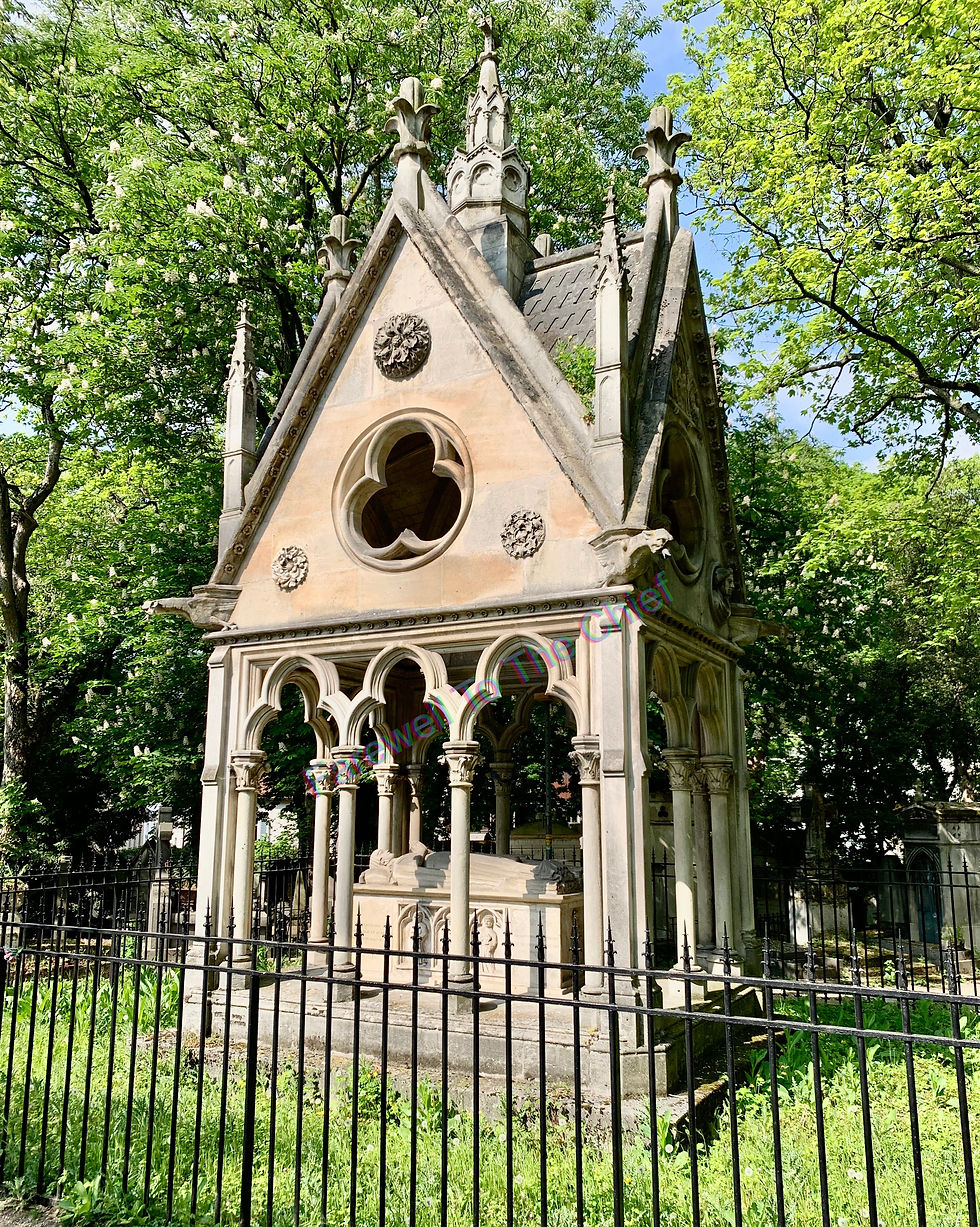
Now that Monroe was back home, at rest in the in Richmond near the high bluffs overlooking the James River, there was a major issue to tend to, how to properly mark his grave. Monroe could have easily been given an obelisk, like his two native peers before him (Jefferson and Madison) or a simple headstone. But as Gov. Wise personally saw to the matter, the end result would not be a simple granite memorial. Wise put out an invitation for designs and received numerous submissions, many of them quite interesting and certainly appropriate for Monroe’s gravesite. In late December 1858, Wise, having looked over numerous designs, selected the submission of architect Albert Lybrock, an Alsatian German who immigrated to the U.S. in 1848 and landed in Richmond in 1852. Lybrock’s design, titled “The Gothic Temple,” is a visually striking Gothic Revival iron work with elegant arches, trefoil patterns, and beautiful tracery. It’s a rather complex memorial with its numerous design elements all of which are captured in a simple rectangle. The front and back side of Lybrock’s memorial is made up of a lancet arch, topped by a rose window tracery, with three round arches below each lancet arch. The two sides are composed up of three lancet arches, consisting of one large arch between two small arches. Each side creates the appearance of a Gothic cathedral window. At each corner at the top of the memorial is a colonette. Together, the four colonettes frame the crown of the memorial, an intricate ogive “perforated canopy” topped by a finial of crockets; the front and back were to have a finial with crockets, but they were removed for the final design. The iron work of Lybrock’s design rises around a faux-granite sarcophagus symbolizing Monroe’s eternal rest; he’s buried several feet below the memorial. This brief explanation of the Lybrock’s work doesn’t offer in the slightest any sense of the beauty of Monroe’s memorial. Missing from this brief explanation is where Lybrock got his inspiration for the design. I can’t provide much information because, well, there just isn’t much in the historical record. (Of course, it doesn’t help that Hollywood Cemetery lost much of its records from a fire in 1865, some of which, I’m sure, contained information on the funeral and Lybrock’s work and possibly, though doubtful, information and sketches of the other designs.) I’ve read two possible sources: the tomb of Henry the 7th in Westminster Abbey and the tomb of Abelard and Heloise in Paris’s famed Pere Le Chaise Cemetery. A quick study of both gravesites shows they each have elements that appear on Monroe’s memorial, but I’d argue the gravesite of Abelard and Heloise is the primary source for Lybrock’s design based on the following: 1) the primary structure encloses a stone sarcophagi; 2) the small corner towers found on the top portion; 3) the finial in the middle of the top portion; and 4) trefoil patterns.
So, what are we left with after this brief sojourn into President Monroe’s famous “Bird Cage” gravesite? Simply put, Gov. Wise made an excellent choice with Lybrock’s design. Since its unveiling in 1859, myriad visitors to Monroe’s gravesite into the present have been awed by its intricacy and prominence. Through the early years it sat alone in a nearly empty plot in the cemetery but over time it has slowly become immersed in a field of simple headstones, vaults, obelisks, angel statuary and fellow President Tyler’s towering granite shaft. Among the field of president gravesites, Monroe’s easily stands out as one of the most beautiful, and certainly more so now that it’s been restored and painted ivory, the memorial’s original color.




-“Obsequies of President Monroe.” Richmond Whig (Richmond, VA), July 9, 1858.
-Henry Jonas Magaziner. The Golden Age of Ironwork, Ocean Pines: Maryland: Slipjack Press, 2000.
-Wood and Cos. Portfolio of Original Designs of Ornamental Iron Work of Every Description. Philadelphia: 1867.


Comments