
A Pauper's Grave.
- abamerica1776
- Jan 22, 2022
- 6 min read
Updated: Jan 24, 2022
John Tyler, when brought up in conversation to those familiar with his name, know him as the first vice-president to assume the office of the president on the death of his predecessor and, if well-versed with his history, as the only former U.S. president to side with the Confederacy, going so far as to secure a seat in the Confederate House of Representatives, but dying before he could serve. Tyler’s death was widely acknowledged throughout the south, his death notice appearing in numerous papers filled with praise, acclaim, and highly complementary descriptions of his accomplishments. His death announcement in northern papers were quite the opposite, peppered with ridicule and scorn, and the underlying theme of treason. When his death was announced, southern papers were quick to relay the news to their readers combined with the requisite obituary and editorial comments. The tune was quite different in northern papers. Keep in mind Richmond and Washington, D.C., are but 110 to 120 miles apart (depending on the route you take). The day Tyler died, reports appeared in northern newspapers about Tyler being in poor health and sick the day of and day after his death; in fact, a cursory search on news of his death didn’t appear until January 21. So, suffice it to say, northern newspapers were either unable to obtain updated news or, what is more likely the case, didn’t care about Tyler’s condition, which is easy to understand given his decision to side with the CSA (Confederate States of America) despite being a former U.S. president. At any rate, back in Richmond, funeral plans were drawn up, Tyler was given the CSA’s first state funeral, and he was interred in Hollywood Cemetery, one of the country’s premiere cemeteries, at least in my opinion. Now this is where the interesting part of the story takes off.
Tyler wrote his Will in October 1859. On the subject of his death, Tyler gave control over the burial of his remains to his wife, Julia, directing her to bury his bones “in the earth of the country where I was born, there to repose till the day of resurrection. My wife will select the spot in Sherwood Forest [it earned this sobriquet because he was labeled an outlaw by his constituents for his strong sectional Southern feelings]…” These instructions are fairly clear but as to how he came to be buried in Richmond’s Hollywood Cemetery was due to a resolution adopted by both houses of the Virginia legislature, “That with the consent of his family his remains be deposited in Hollywood Cemetery, in the city of Richmond, near the remains of James Monroe…” Although stipulated in his Will to be buried at his home, I suspect the resolution to inter him in Hollywood Cemetery’s was in keeping with former Gov. Wise’s effort to inter Virginia’s presidential sons in the government purchased plot appropriately titled “President’s Plot” that already laid claim to President Monroe. But there is also an intimation the move was due Confederate and state authorities and family concern over Union troops defiling his grave.
The second part of his burial wishes provided in his Will concerned his gravesite, writing “and mark it by an uncostly monument of granite or marble.” The second part of the aforementioned resolution, “…and that the Governor of this State be authorized to cause a suitable monument to be erected to his memory.” And this is where the wheels fell off.
It’s expected that any time a single government official is tasked with overseeing a project that patience is necessary. But this was an unusual time for the state of Virginia as the Civil War was in full motion. Governor John Letcher was facing a monumental task managing his state’s response to the demands placed on it by the Civil War and the, in comparison, minor task of placing a monument over Tyler’s grave was the least of his concerns. Unsurprisingly, Letcher never got around to placing a monument over Tyler’s grave and it remained void of a monument for nearly four decades, the longest of any president; in fact, the only other president who comes close to Tyler’s timeline was the revered and esteemed Madison at just over 20 years with a barren gravesite.
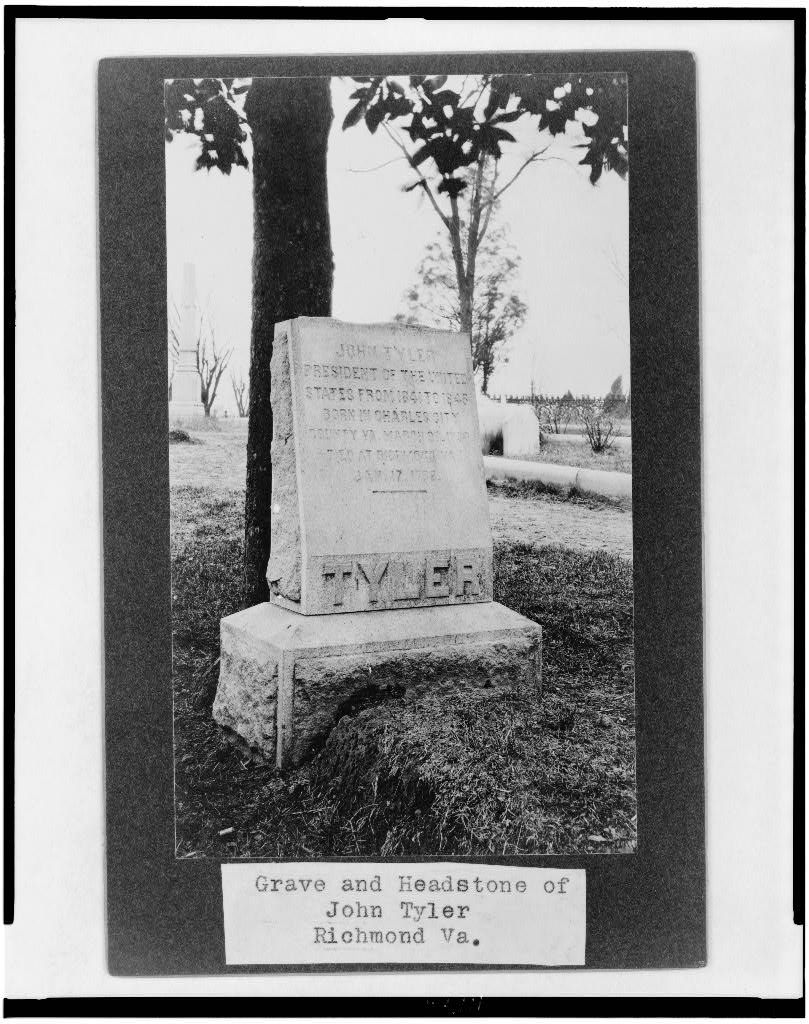
Is there any explanation for why Tyler’s grave went unmarked for a few decades? I’ve not been able to locate any smoking guns despite my best attempts and limited resources. It is simply a case, much like that of William Henry Harrison’s deplorable family vault, of neglect, a forgotten entity, that occasionally received some bluster from the public directed at the state government to improve Tyler’s grave that led to no action. Even after the death of his wife, Julia, in July 1889, who was buried at his side, no improvements were made; she was under the impression the state would at some point erect a monument over her husband’s grave despite 27 years of inactivity. Tyler was much revered, a heralded champion of the Southern cause in Virginia during the early days of the Civil War and well after its end. He wasn’t just another slave-owning, wealthy plantation owner. He was a former Virginia governor, senator, vice-president (albeit for one month) and a nearly full-term president who annexed Texas into the Union through a simple Senate majority vote for what is perhaps his single greatest accomplishment as President. This abbreviated list of accomplishments makes the mystery around his barren gravesite all the more difficult to figure out, even when you excuse Governor Letcher from his responsibility. In October 1899, when the VA legislature failed yet again in securing monies to the tune of $10,000 for his gravesite, the Hollywood Cemetery Company took matters into its own hands and secured a granite headstone, that, even with the wrong death date (1/17 was chiseled into the granite, rather than 1/18), gave the Tyler gravesite an identity it had been lacking since 1862. But this is not where the story ends.
How Tyler’s gravesite came to be what it is today echoes a similar course of events that resulted in a new obelisk for Thomas Jefferson’s gravesite. In 1908, Ohio Rep. William A. Ashbrook was visiting Richmond (reason unknown) and spent some time in Hollywood Cemetery. He was quite bothered by the poor, dilapidated condition of Tyler’s grave and shortly after his return to Washington, D.C., he introduced a House bill in late January, H.J. Res. 106, to establish a permanent committee responsible for placing monuments at deceased President gravesites. After the introduction of his bill, it was reported as creating a committee to look into the conditions of deceased President gravesites, whether they are marked or improperly marked, and allocating $25,000 for a monument for Tyler’s gravesite. Although his bill did not result in Tyler’s grave being graced with a new monument nor the establishment of a permanent committee, had the monies been approved, I can only guess at the size of Tyler’s monument and imagine it being a massive, intricately carved monument. The same year, Virginia Senator Thomas Martin introduced bill No. 3662 to the Committee on the Library to secure $10,000 for a monument but passage failed. In 1909, fellow Virginia Senator John Daniel reintroduced Martin’s bill to the Committee on the Library, where it went unconsidered for several months. In June 1910, Daniel died, and former Virginia Governor Claude Swanson was appointed to serve the remainder of Daniel’s seat. Swanson, serving on the same committee, quickly got to work and took up the bill during the first committee meeting. On the same day it was introduced, the bill was passed. It was then introduced to the Senate and won passage. Although this was a major victory, the bill still needed to win passage in the House. Virginia Representative Capt. John Lamb, who supported the bill, rather than introducing the one he wrote for the same purpose, reported it to the House Library Committee a few days before Congress adjourned. By sheer will, Lamb managed to get the bill passed and with it, on Thursday, March 4, 1911, the bill was passed and new Tyler’s monument was secured.
But there was a slight problem as the Secretary of War, Henry Stimson, tasked with overseeing the Tyler monument act, couldn’t proceed as it was “discovered that Congress omitted an appropriation so that he will be obliged at the approaching session to call attention to this omission and a request a direct appropriation.” This oversight was soon corrected but despite this Stimson would not allow any money to be spent until a legal association was created to oversee the care and maintenance of the monument and plot without expense to the U.S. government. Hollywood Cemetery assumed responsibility for the monument but only after the monument was placed. With this matter settled, the U.S. Army Chief of Engineers appointed an officer from the U.S. Army Corps of Engineers to oversee construction, bids and designs for the monument, expenses, and correspondence. In December 1913, a call went out for design submissions and after review, the Washington, D.C., Commission of Fine Arts selected the design of T. F. McGann and Sons Co. of Boston, Massachusetts and come Wednesday, June 9, 1915, the monument was unveiled. Fifty-three years later, the pauper’s grave was finally and appropriately marked in a manner befitting Tyler’s former title as our country’s tenth commander-in-chief.



Comments